
B-17 RADIO OPERATOR / GUNNER
92nd Bomb Group, 326th Squadron
USAAF SERVICE No. 32709661
Technical Sergeant Gerald A. Hirsch (1922-2006), from Rego Park in New York City, was a two-time recipient of the Distinguished Flying Cross for his actions as a B-17 airman in World War 2. Participating in some of the fiercest airborne campaigns during the Summer and Fall of 1944, Jerry provided critical strategic bombing support over Normandy on D-Day. Flying out of the 92nd Bomb Group in Podington, England, Jerry was stationed just 15 miles from Kimbolton — which hosted the 379th Bomb Group and his brother John.


PFF (PATHFINDER FORCE)
CUTTING-EDGE TARGET MARKING
Airmen who entered the USAAF with specialized skills, or who displayed particular aptitude, were screened for specialized roles. Jerry was chosen to train as a Radio Operator, a key role on any B-17 — but especially vital on PFF (Pathfinder Force) aircraft, special advanced bombers that would later play a significant role in his tour of duty.
To be selected for a PFF aircrew required top qualifications at navigation, radar operation, and target marking. These specially-outfitted B-17s used cutting-edge radar and targeting technology to execute highly accurate bombing runs even in extremely inclement weather. Dangerously, a PFF plane’s role in target marking meant that they were also the first of the group to fly over mission airspace.
ASSIGNED TO THE 326th BOMB SQUADRON
PODINGTON, ENGLAND
On May 28th 1944, Jerry was assigned to the squadron he would be attached to for the rest of his deployment: the 326th, part of the 92nd Bomb Group stationed in Podington, England. That same day, 2nd Lt. Bernard P. Klyza — an officer and pilot from Wilkes-Barre, PA — also joined the squadron.
Though they didn’t yet know it, Lieutenant Klyza and Sergeant Hirsch were bound by fate: Klyza would end up sitting in the pilot’s seat for 21 of Jerry’s 30 total combat missions. Both would survive the war.


June 6, 1944 (D-Day)
June 6, 1944: D-Day
The Skies Over Normandy
Only a week after being assigned to the same aircrew, Lt. Klyza and Sergeant Hirsch flew their first mission together on June 4th, 1944. Just two days later, June 6th, was Operation Neptune and D-Day. It was Jerry’s second combat mission ever, and Lt. Klyza’s third. The pair would need to quickly cement their fledgling trust in one another amidst the flak-filled skies over Normandy. Flying a B-17 named “Sky Scrapper,” Hirsch and Klyza’s crew was one of 85 total bombers sent from the 92nd to soften coastal defenses for the thousands of infantrymen preparing to land ashore.
DISTINGUISHED FLYING CROSS AWARDS
FOR EXTRAORDINARY ACHIEVEMENT
The Distinguished Flying Cross is the highest medal for aerial heroism in the United States military. According to the US Air Force:
“[The DFC] is awarded to any officer or enlisted person of the armed forces of the United States for heroism or extraordinary achievement while participating in aerial flight. Both heroism and achievement must be entirely distinctive, involving operations that are not routine. This award is not awarded for sustained operational activities and flights.“
Jerry’s second DFC award was described in raw detail in the 8th Air Force Headquarters announcement. Per the official report by command, Jerry’s plane was struck repeatedly by anti-aircraft fire (flak), killing the ball turret gunner and badly wounding several other men. A fire broke out in the plane’s waist, where the waist gunner S/Sgt Ernest Eickholz was unconscious. T/Sgt Hirsch extinguished the flames, pulled the wounded man to safety, and immediately rendered first aid. Sergeant Eickholz (1915-1993) would survive the war.
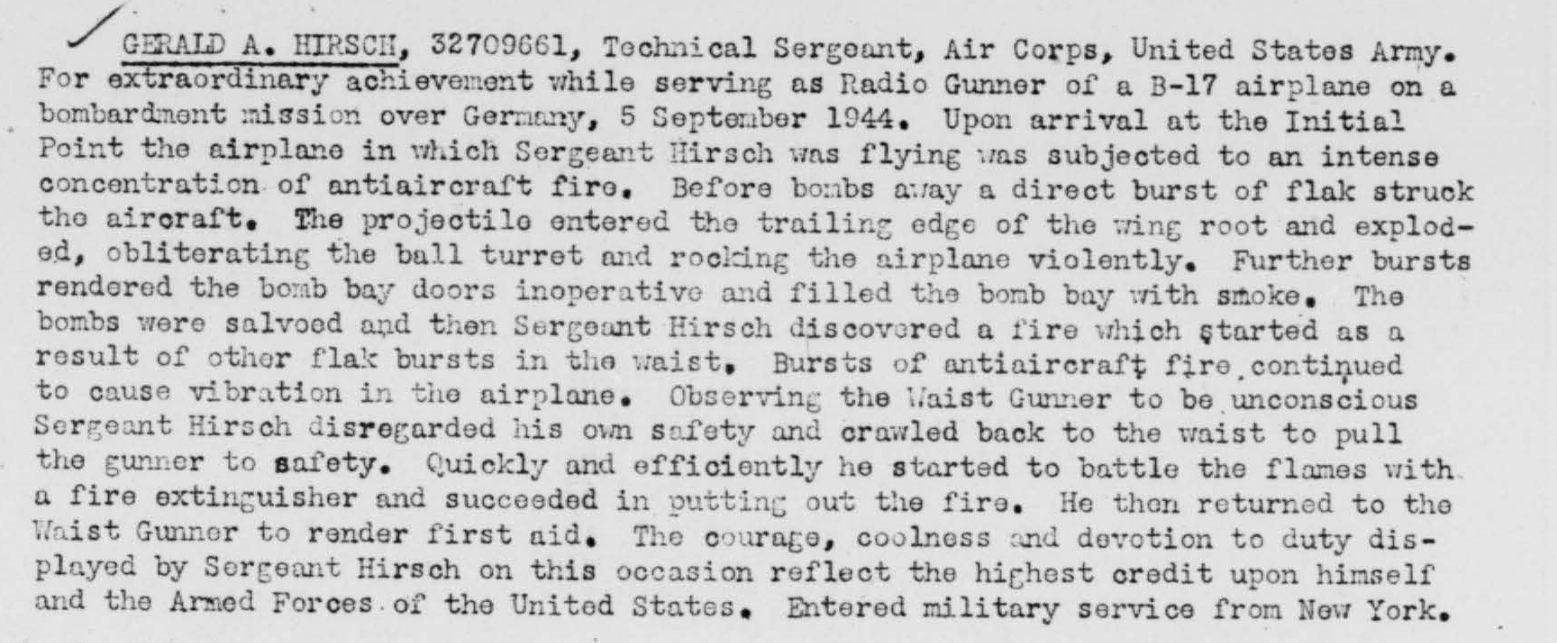
This incident occurred on September 5th 1944, on Jerry’s 29th mission of the required 30 to complete a tour of duty. He wouldn’t fly his final one for another 25 days after the ordeal.


Of the 2.4 million airmen who served during WW2, about 4% received the Distinguished Flying Cross.
(per USAAF data)


30 MISSIONS AND TOUR COMPLETE
SEPTEMBER 30, 1944
According to US Army statistics, the average lifespan for a B-17 airman was 11 missions, with a worse than 50% chance of survival on any given flight. Yet, Jerry completed a full 30 mission tour of duty — and on October 1st 1944, his war was over. He was reassigned away from the theater of operations and would not see combat ever again.
Jerry’s 30th and final mission was on September 30th, 1944, where he was given the somewhat dubious honor of flying on the “lead team” — the plane flying out in front in the group formation. Typically, the lead planes would be crewed by the unit’s highest-ranking officers as both a real and symbolic gesture of leadership by example (given the danger inherent in arriving first over the target). The lead crews were also often the most experienced and skilled, adding a pragmatic reason for flying them over target first.
In recognition of the special occasion on Jerry’s final mission, he was joined on the lead team by Major Albert Cox (1914-2003) who was flying his 32nd combat mission — only halfway to his eventual total. Cox would later be promoted to Colonel and Squadron Commander, and he continued leading from the front until the end of the war. He had been continuously flying bomber combat operations since at least August 1943.
Complete map of all 30 combat missions
Flown by T/Sgt GERALD A. Hirsch
- Équihen-Plage, France
- Longues-sur-Mer, France
- Kerlin, France
- Conches-en-Ouche, France
- Lille, France
- Brétigny-sur-Orge, France
- Nantes, France
- Villers-l’Évêque, Belgium
- Hamburg, Germany
- Pas-de-Calais, France
- Berlin, Germany
- Bientques, France
- Leipzig, Germany
- Munich, Germany
- Peenemünde, Germany
- Köthen, Germany
- Schweinfurt, Germany
- Merseburg, Germany
- Schleißheim, Austria
- Orléans, France
- Merkwiller-Pechelbronn, France
- Hannover, Germany
- Brandenburg, Germany
- Caen, France
- Trier, Germany
- Ludwigshafen, Germany
- Münster, Austria
Click on a PIN to learn more about JERRY’S WW2 experience

Équihen-plage, France
Longues-sur-Mer, France
Kerlin, France
Conches-en-Ouche, France
Lille, France
Bretigny-sur-Orge, France
Nantes, France
Villers-l’Évêque, Belgium
Hamburg, Germany
Pas-de-Calais, France
Hamburg, Germany
Berlin, Germany
Bientques, France
Leipzig, Germany
*joint operation between 92nd BG & 305th BG (PFF)
JULY 11, 1944
Radio operator / gunner
B-17 (PFF serial no. unknown)
Leipzig, Germany
*joint operation between 92nd BG & 305th BG (PFF)
Munich, Germany
*joint operation between 92nd BG & 305th BG (PFF)
JULY 18, 1944
Radio operator / gunner
B-17 (PFF serial no. unknown)
Peenemünde, Germany
*joint operation between 92nd BG & 305th BG (PFF)
Köthen, Germany
*joint operation between 92nd BG & 305th BG (PFF)
Schweinfurt, Germany
*joint operation between 92nd BG & 305th BG (PFF)
JULY 28, 1944
Radio operator / gunner
B-17 (PFF serial no. unknown)
Merseburg, Germany
*joint operation between 92nd BG & 305th BG (PFF)
JULY 31, 1944
Radio operator / gunner
B-17 (PFF serial no. unknown)
Schleissheim, Germany
*joint operation between 92nd BG & 305th BG (PFF)
Orléans, France
Merkwiller-Pechelbronne, France
Hannover, Germany
Brandenburg, Germany
Caen, France
AUGUST 14, 1944
Radio operator / gunner
B-17 42-98005
Trier, Germany
AUGUST 24, 1944
Radio operator / gunner
B-17 42-98005
Merseburg, Germany
SEPTEMBER 5, 1944
Radio operator / gunner
B-17 42-98005
Ludwigshafen, Germany
*plane hit, multiple casualties; Jerry receives 2nd Distinguished Flying Cross
Münster, Germany
*Jerry’s final mission; flew in lead bomber accompanied by Major Albert L. Cox
SELECTED IMAGE GALLERY


SERVICE WORTH REMEMBERING
I created Hirsch WW2 after discovering that there was no publicly available trace of my grandfather John P. Hirsch’s wartime service. During the research process I was pleasantly surprised that my great-uncle Jerry’s information, though still difficult to find and compile, was retrievable in a much more complete state than my grandfather’s. Although I didn’t know him well, through this journey and the discoveries made, I came to greatly admire and respect Jerry’s wartime story. The effort to tell that story through this digital record is my small tribute in appreciation of what he did.